Wreck Bay, Two Years On — PFAS Liability Is Moving Upstream
The contamination remains. The questions of responsibility are moving closer to where the chemistry began.
In April 2024, PFAS Free Australia asked a relatively simple question:
When PFAS contamination occurs, who should ultimately carry the cost — the end user of the product, or the manufacturer of the chemistry that created it?
At the time, the question formed part of our commentary on How to Poison a Planet, the documentary that brought renewed attention to the history of PFAS manufacture and its consequences around the world.
Importantly for Australia, the documentary also brought the experience of the Wreck Bay Aboriginal community at Jervis Bay into confronting focus.
Two years later, the question we asked has become considerably less theoretical.
Wreck Bay was never simply about compensation
PFAS contamination associated with the historic use of firefighting foams at Defence facilities has left a difficult legacy across Australia.
At Wreck Bay, that legacy became particularly personal.
In 2023, the Commonwealth reached a $22 million settlement with the Wreck Bay Aboriginal community over PFAS contamination associated with Defence activities in the Jervis Bay area. The proceedings included claims relating to property-value loss, loss of use and enjoyment of land, and cultural loss.
In our April 2024 commentary, we questioned whether financial settlement could ever properly be characterised as resolution when contamination remained, remediation challenges persisted, and environmental and cultural consequences extended beyond the settlement itself.
We wrote then:
“But is the determination of a quantum paid by the Defence Department (with no acceptance of liability) a win? It cannot be judged as such.”
The question remains relevant.
Financial settlement can recognise loss.
It cannot necessarily restore contaminated land or water, remove persistent chemistry from the environment, or undo the consequences for communities required to live with that legacy.
And settlement does not answer another fundamental question:
Where should responsibility ultimately begin?
The liability conversation is moving upstream
On 28 May 2026, the Commonwealth commenced Federal Court proceedings against 3M Company and 3M Australia Pty Ltd seeking more than $2 billion in damages associated with PFAS contamination at 28 Defence bases across Australia.
The Commonwealth alleges, among other things, that 3M withheld information about the environmental risks associated with its aqueous film-forming foam, did not fully disclose what it knew, and made representations concerning disposal and environmental safety that were inconsistent with its knowledge at the time.
These remain allegations before the Court, and 3M has said it will defend the proceedings.
The eventual legal findings will matter.
But there is already a broader significance in where the argument is heading.
The PFAS conversation is moving beyond the consequences of contamination and toward questions about the chemistry, the product, the information available about it and the responsibilities of those involved before the contamination occurred.
In 2024, PFAS Free Australia asked:
“Are these costs to be borne by the end user or does the manufacturer of the source chemical shoulder the full liability?”
In 2026, that question is no longer hypothetical.
Remediation starts at the end of the problem
For much of the PFAS debate, attention has understandably concentrated on contaminated water and soil, affected communities, remediation and compensation.
All are essential.
But they occur after the chemistry has entered the system.
Once persistent chemistry has moved through products, workplaces, waste streams, soil and water, managing the consequences becomes technically difficult, commercially expensive and potentially generational.
The scale of Australia’s response illustrates the point. Defence says it has already spent more than $1.3 billion responding to PFAS contamination, including investigation, management, remediation and support for affected communities.
That suggests another question deserves considerably greater attention:
What could have prevented the contamination from occurring in the first place?
This is where the PFAS conversation needs to move.
Not away from remediation.
Upstream from it.
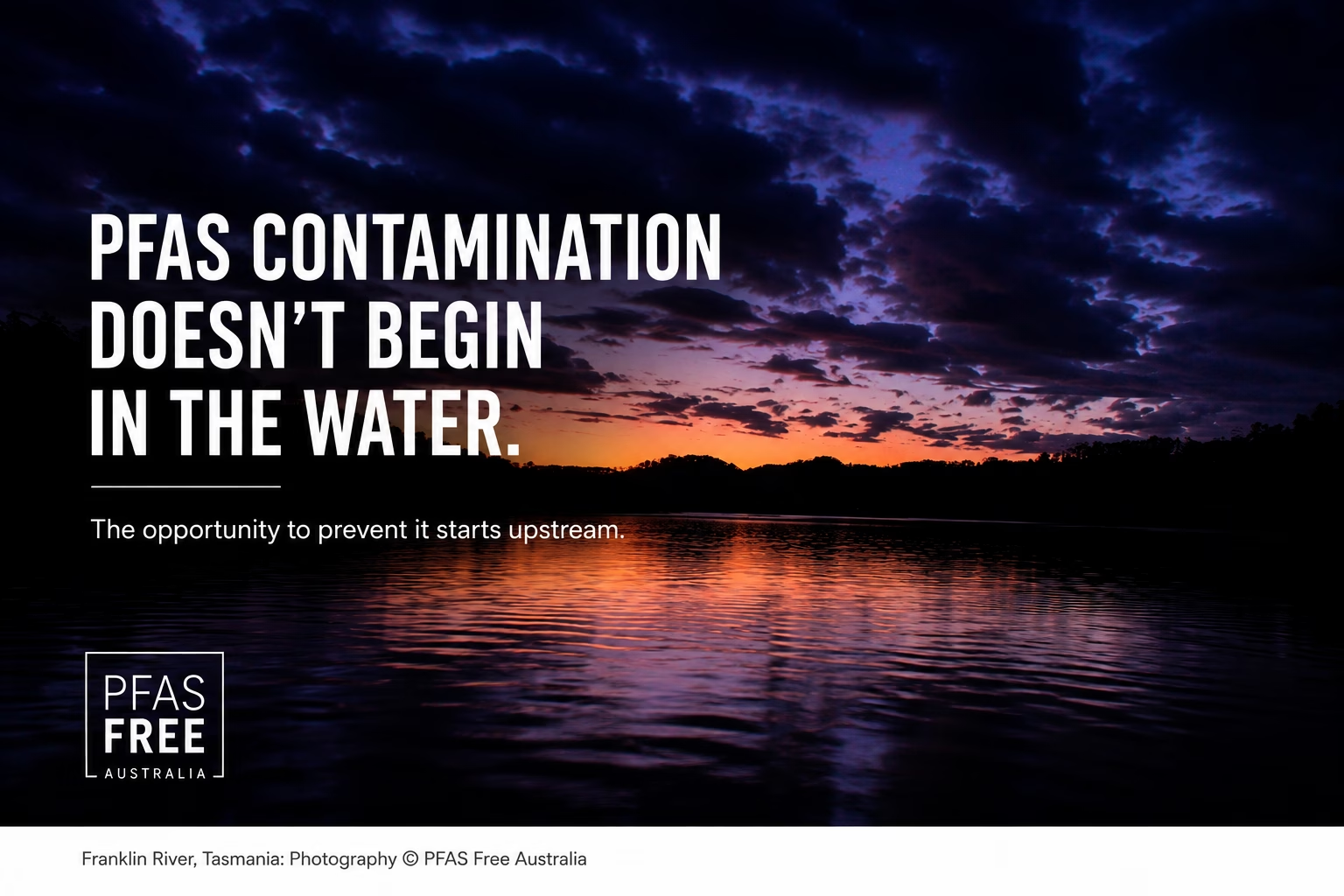
PFAS contamination doesn’t begin in the water
It begins much earlier.
It begins with chemistry.
With formulation.
With product design.
With manufacturing.
With purchasing decisions.
And with the information available to organisations making those decisions.
The emerging PFAS question therefore cannot simply be:
How do we clean this up?
Increasingly, it must also be:
What did we know about the chemistry before we bought the product — and what should procurement know before buying the next one?
Because the cheapest PFAS contamination to manage is the contamination we avoid creating in the first place.
The product claim is part of the same conversation
There was another observation in our April 2024 commentary that deserves revisiting.
PFAS Free Australia anticipated increasing demand for the testing and validation of products represented as PFAS-free and questioned the adequacy of declarations such as “No Added PFAS.”
Two years later, variants including “No Intentionally Added PFAS” have become increasingly commonplace across packaging and other product supply chains.
That represents progress in one sense. Awareness has increased.
But terminology alone cannot provide confidence.
The important question remains:
What evidence supports the claim?
As PFAS regulation develops and expectations around chemical stewardship increase, manufacturers, importers, converters, procurement teams and brand owners will increasingly need to understand not simply what their supplier declares, but what evidence supports that declaration.
This is not about making procurement unnecessarily difficult.
It is about making better-informed decisions before environmental consequences make those decisions considerably more expensive.
Two years later
Wreck Bay reminds us why this matters.
The consequences of persistent chemistry can survive long after the original product has disappeared, the purchasing decision has been forgotten and responsibility has become difficult to untangle.
The current Federal Court proceedings may eventually help determine where some of that responsibility lies.
But there is another lesson available to us now.
Good stewardship should begin before contamination becomes a remediation problem.
Two years ago, we asked who should pay once the damage had occurred.
Perhaps the more important question for the years ahead is:
What should we know before allowing the chemistry into the system at all?
PFAS Free Australia
Independent information. Better questions. Better informed decisions.