26 August 2026
For several years, much of the Australian discussion around PFAS in fibre-based food packaging has centred on a relatively simple question:
Has PFAS been intentionally added?
That has been an important starting point.
It may no longer be a sufficient finishing point.
Australia’s management of chemicals of concern is evolving. PFAS restrictions are progressively being implemented through the Industrial Chemicals Environmental Management Standard (IChEMS), while broader packaging reform is considering restrictions on chemicals of concern and greater responsibility for packaging placed onto the Australian market.
For paper, board and fibre packaging, this raises an important practical question.
What exactly is the product being assessed?
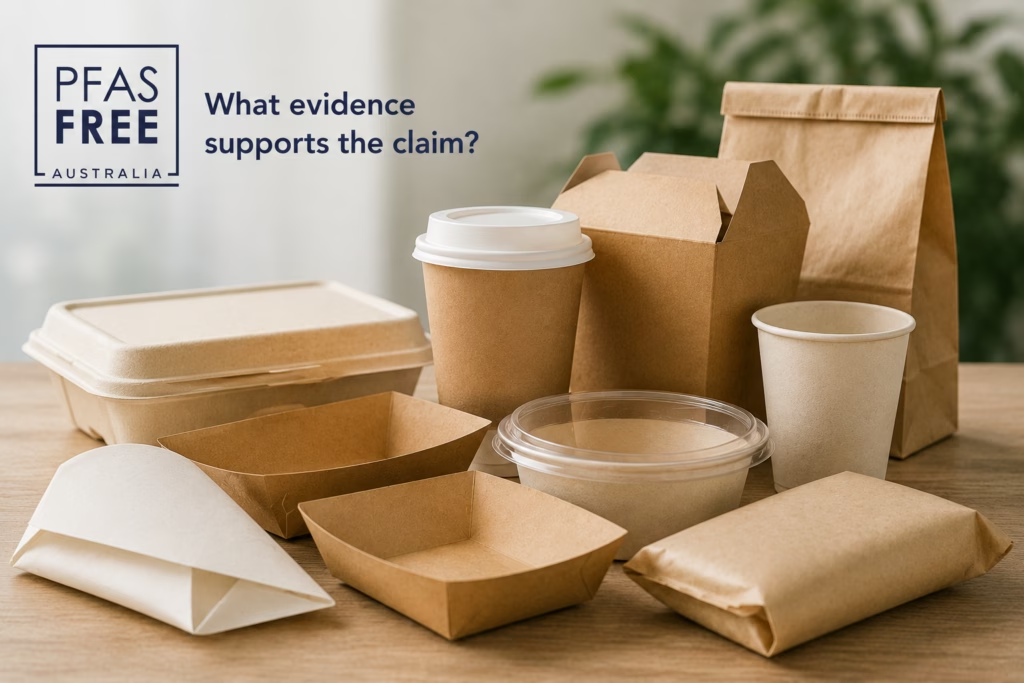
A food package is rarely just a sheet of paper or board.
The finished article may incorporate:
- the underlying fibre substrate;
- internal or surface sizing;
- functional or barrier coatings;
- printing inks;
- overprint varnishes;
- glues and adhesives; and
- other treatments introduced during converting.
PFAS have historically been associated with several of these material and chemical categories.
Consequently, evidence relating only to the base paper or board does not necessarily describe everything subsequently incorporated into the finished package.
Neither does a statement that PFAS have “not been intentionally added” necessarily answer a different question:
What is actually present in the finished packaging article?
These are not the same proposition.
Declaration, verification and assurance
Supplier declarations remain useful.
They provide information about formulation intent and can form an important part of responsible procurement.
But a declaration is not necessarily verification, and verification of one component is not necessarily assurance of the finished package.
PFAS Free Australia believes the next stage of responsible packaging stewardship should progressively consider the complete evidence chain:
Declaration → Verification → Assurance
That does not mean every package requires indiscriminate testing.
It means that a credible claim should be supported by evidence appropriate to the claim being made — including an understanding of the substrate, coatings and converting inputs; appropriate analytical methodology where required; identifiable product and sample provenance; and controls over changes that could alter the PFAS status of the finished product.
The distinction matters
This is not simply a question of terminology.
Paper and fibre packaging is being asked to perform functions historically achieved using increasingly complex chemical treatments while simultaneously satisfying food-contact, recycling, compostability and environmental expectations.
As those expectations increase, confidence cannot rest indefinitely on formulation intent alone.
The important question for manufacturers, converters, importers, brand owners and purchasers is therefore beginning to change.
Not simply:
“Was PFAS intentionally added?”
But increasingly:
“What evidence gives us confidence about the PFAS status of the finished package we are placing on the market?”
That is a more demanding question.
It is also the beginning of an Assurance mindset.
PFAS Free Australia — advancing evidence-based assurance for paper, board and fibre packaging.
Sources and further reading
Australian Government Department of Climate Change, Energy, the Environment and Water
Sustainable packaging — chemicals of concern and packaging reform
Industrial Chemicals Environmental Management Standard (IChEMS)
National framework for managing industrial chemicals in Australia
IChEMS — products and articles
Government guidance concerning chemicals in products and articles, including packaging
PFAS National Environmental Management Plan (PFAS NEMP)
National guidance concerning PFAS sources, uses and environmental management