As Australia considers how responsibility for packaging should extend across its lifecycle, there is another question worth asking: should information about the chemistry inside that packaging travel with it too?
Australia’s packaging conversation is changing.
For years, much of the focus has understandably been on what happens after packaging has served its primary purpose: whether it can be collected, sorted and recycled; how much is recovered; what happens to the material next; and who should carry responsibility for managing it.
Those questions remain important.
In September 2026, Australia’s Federal, State and Territory environment ministers reaffirmed packaging reform — including soft plastics — as an environmental priority. They agreed to continue working together and with industry to strengthen packaging regulation as part of a broader national agenda addressing recycling and the circular economy.
That national cooperation matters. Australia’s packaging framework is national in intent, but responsibility for implementing parts of it is shared across jurisdictions. The current system combines the industry-led Australian Packaging Covenant, administered by APCO, with the National Environment Protection (Used Packaging Materials) Measure, which is given effect through legislation and arrangements in each State and Territory. While governments consider how that framework should be strengthened, the existing arrangements remain in place.
So the discussion is not simply about what packaging is placed on the market. It is also about what happens to that packaging — and the materials within it — when its first use ends.
But responsibility for packaging begins much earlier than the recycling bin.
Decisions about substrates, coatings, barriers, adhesives, inks and chemical treatments are made before a package ever reaches the consumer — and long before it reaches a recycling facility.
Those decisions help determine not only whether packaging performs its intended function, but what eventually enters Australia’s recovery and recycling systems.
If responsibility is going to follow packaging further through its life, shouldn’t the information needed to understand those decisions follow it too?
Responsibility starts upstream
Extended Producer Responsibility — EPR — has become an important part of Australia’s packaging reform discussion.
In the Australian Government’s 2024 consultation on packaging reform, more than 80% of respondents preferred Commonwealth regulation of packaging. Fifty-five per cent preferred an extended producer responsibility scheme with mandatory requirements, rising to 65% when responses supporting EPR as part of a hybrid model were included.
The consultation also recorded strong support for nationally consistent restrictions on a limited set of problematic packaging inputs, with PFAS among the examples identified.
Those consultation results do not determine the regulatory model Australia will ultimately adopt. But they do point towards a broader concept of responsibility across the lifecycle of packaging.
That raises another question.
If producers are expected to accept greater responsibility for what happens to packaging downstream, what responsibility exists for the material and chemical decisions made upstream?
A package is not simply paper, plastic or fibre.
A fibre-based food package, for example, may include the substrate itself, a barrier coating, adhesives, printing inks, varnishes and other treatments introduced to provide grease, moisture or heat resistance.
Those decisions become part of the package that eventually enters the next stage of its life.
Material circularity also has a chemistry dimension
The Australian Government’s current work on packaging already recognises that sustainable packaging design involves more than recyclability alone. Alongside reduction, reuse, recycled content and recyclability, the Government identifies removing harmful chemicals from packaging as part of improving circularity.
The stated objective is packaging capable of being recovered, reused, recycled and reprocessed safely.
PFAS provides a useful example of why this matters.
In May 2026, APCO released a discussion paper examining whether its existing approach to PFAS in fibre-based food-contact packaging should be expanded. Among the issues being considered are broader packaging coverage, PFAS testing methodologies, evidence requirements and future guidance.
The Australian Government has also connected the phase-out of PFAS in fibre-based food-contact packaging with improving the quality of recycling and composting streams.
The important point is that a material may change form, but the history of that material does not simply cease to exist when the package is discarded.
Knowing where a material goes is important. Knowing what is travelling with it may be equally important.
This conversation is not confined to Australia
Internationally, packaging innovation is increasingly confronting the relationship between material choice, product performance, chemistry and end-of-life.
On 16 September 2026, the Ellen MacArthur Foundation launched the PaperFlex Consortium, bringing together Colgate-Palmolive, Mars, Nestlé, PepsiCo, Procter & Gamble and Unilever to accelerate the development of responsibly designed paper-based alternatives to flexible plastic packaging.
The significance is not simply the substitution of plastic with paper.
The broader challenge is to develop packaging that performs its required function, works within recovery systems and avoids replacing one environmental problem with another.
Changing the substrate does not remove the need to understand the chemistry.
Moving to fibre, recycled content or another alternative material may change the environmental profile of a package. But coatings, barriers, adhesives, inks and other functional treatments may still be necessary.
That makes understanding the finished package increasingly important.
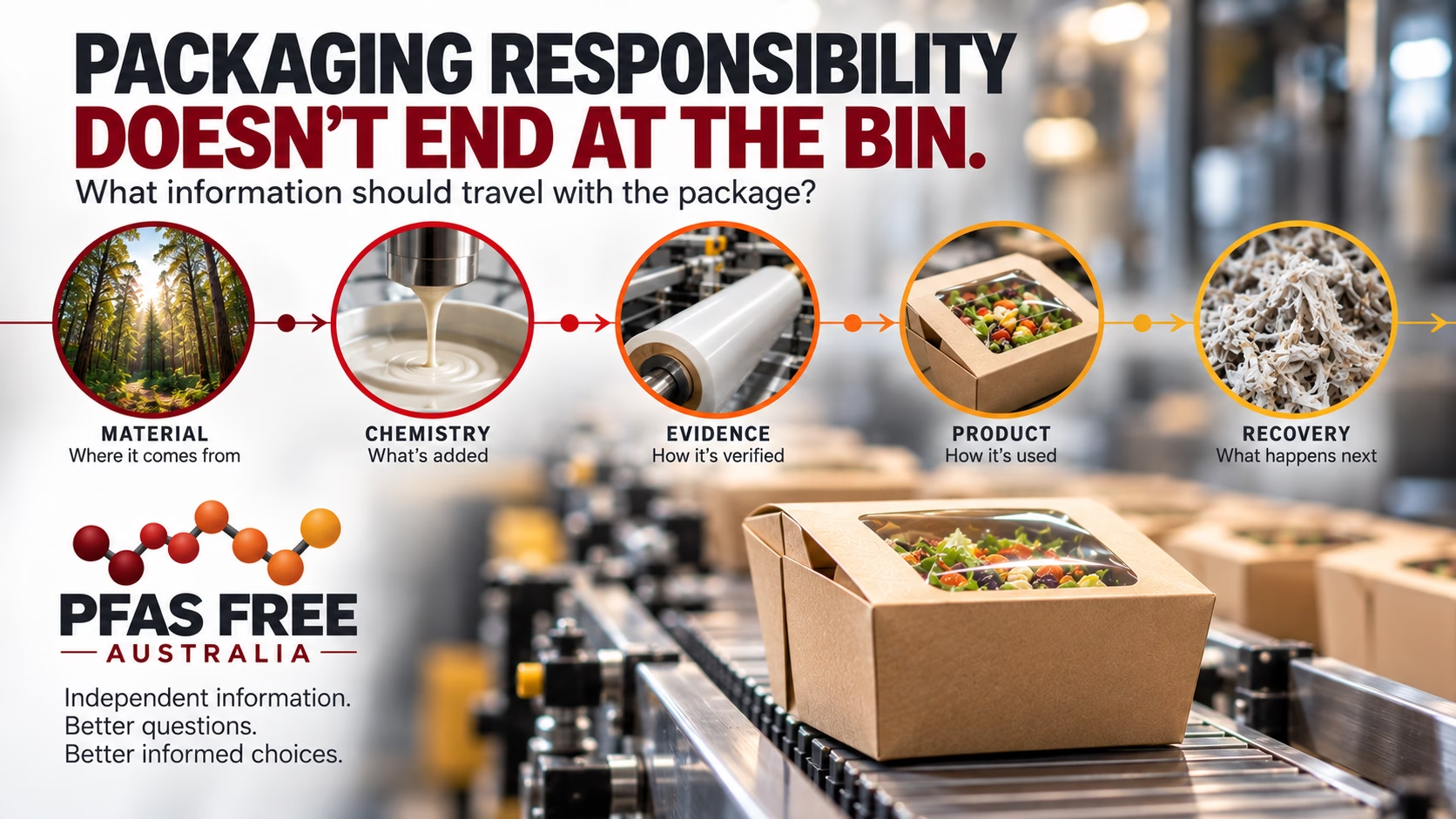
What information should travel with the package?
Consider the journey of a package.
A material is selected. Chemistry may be introduced to achieve performance. Evidence is created — or should be — about those materials and treatments. The package is converted, filled, distributed and used. Eventually it enters a recovery system.
At each stage, information can exist about what the product is, what has been added to it and what evidence supports the claims made about it.
The question is whether that information survives the journey as effectively as the physical product does.
Was the chemistry known?
Was it simply declared by a supplier, or was the declaration supported by evidence?
If testing was undertaken, what exactly was tested?
Did the sample represent the finished package supplied to the Australian market, or only one substrate or component?
If a coating, formulation, raw-material supplier, manufacturing facility or process changed, would that information travel with the product?
The waste and recycling industry should not have to reconstruct upstream chemistry decisions after the product has already become waste.
From product responsibility to evidence responsibility
This may become one of the less visible consequences of a stronger product stewardship approach.
Responsibility is not only about who pays for collection or recovery. It can also raise questions about whether enough information exists through the supply chain to understand the product being managed.
That does not mean every recycler needs to become a chemist. Nor does it mean every participant in a packaging supply chain should independently test every package.
And one laboratory result cannot answer every question.
It does suggest something simpler:
The evidence should be capable of travelling with the claim.
That evidence might include material identity, relevant chemical information, supplier declarations, appropriate testing, identification of the product and sample tested, records of formulation or supply changes, and provenance connecting the evidence to the product actually being supplied.
These questions become increasingly important as environmental claims, chemical restrictions and circularity expectations begin to converge.
Better responsibility requires better information
Australia’s packaging framework will continue to evolve.
The regulatory mechanisms may change, and consultation, policy development and voluntary initiatives should not be confused with legal obligations that have not yet been established.
But there is a principle worth considering regardless of the final regulatory architecture.
If responsibility follows packaging through its lifecycle, the information needed to understand that packaging should follow it too.
A package arriving at a recycler carries more than a material classification. It carries the history of decisions made about substrates, coatings, barriers, treatments and performance.
If Australia wants greater confidence in what it recovers, reprocesses and keeps in circulation, understanding that history may ultimately be just as important as knowing which bin the package entered.
PFAS Free Australia
Independent information. Better questions. Better informed choices.